A First Visit to the Local Archive
A focused question, a careful catalogue search and a simple reference log can turn a first archive visit into a useful start on local research.
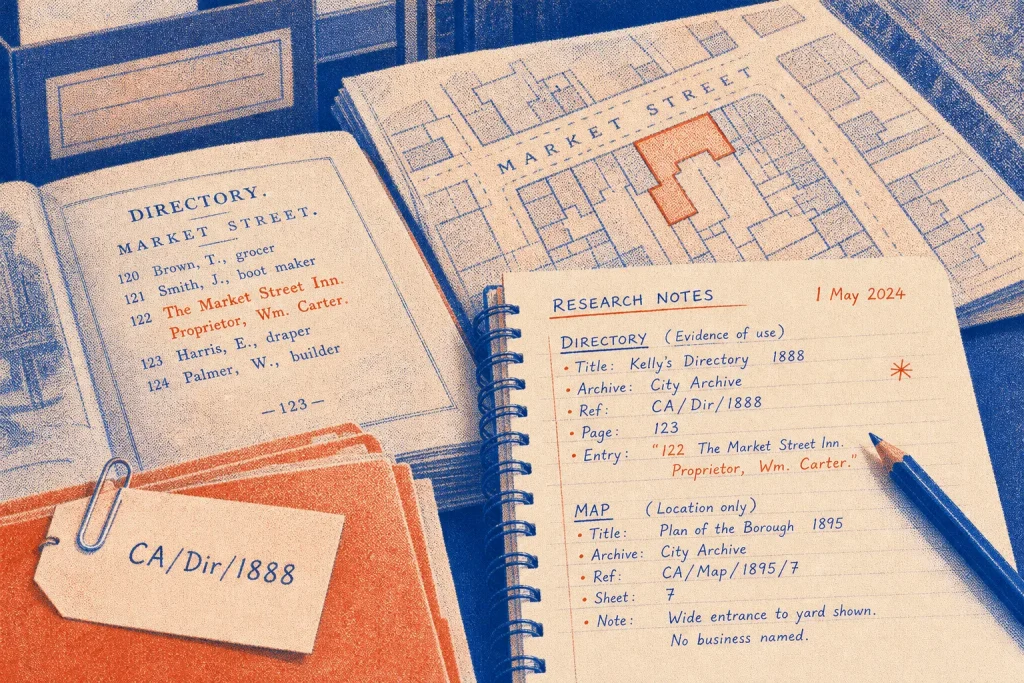
What can you realistically learn about an old building in one afternoon at the local archive? Begin with a question narrow enough to search, then use the visit to identify records, understand their limits and leave with references that point to a useful next step.
A focused question
Say you are curious about the former coaching inn on Market Street, now divided into flats. It has a painted signboard and a wide carriage entrance, but you do not know when it stopped taking guests. “What is the history of the inn?” is too broad for a first visit: it could lead into ownership, architecture, trade and residents.
Instead, ask: “What records name the Market Street premises as an inn, and what dates do they cover?” This wording does not assume that the current name is the oldest one. It gives you a place and a specific kind of evidence to look for.
Before travelling, check the archive’s website or contact its staff. Reader registration, opening arrangements and document requests vary. Ask whether the catalogue is searchable remotely and whether likely records need to be ordered in advance. A brief enquiry that gives the street and your question is easier to answer than a request for staff to research the whole building.
Catalogue searches
At the archive, consult the catalogue’s search guide or ask how entries are organised. A catalogue describes records held by the archive, but may not list every document within a collection. Its descriptions can also use historical terms that differ from current language.
For the inn, search the street name, the current or remembered building name, “coaching inn” and a nearby landmark. If the exact-name search returns nothing, try an older street name or a broader collection heading. If it returns too much, narrow by place, date or record type. Note which search terms lead to relevant catalogue entries; this is more useful than recording every click.
Trade directories, maps, rate books, licensing records, photographs and building plans may offer different kinds of information. A directory can name a business or occupant. A map can help locate a property. Neither necessarily explains how the building was used throughout a period. Read each catalogue description in full, including the collection title, reference code, date range and access conditions, before ordering an item.
Reading records
When a document arrives, follow the archive’s handling instructions. Staff may provide supports or ask you to keep pages in order. Use only permitted pencils and devices, and ask before moving a fragile item. Check photography rules before taking pictures; permission, flash and reproduction conditions may vary.
Start by noting the document’s title or description and full reference. Then check its date, creator and purpose. A licensing entry, for instance, might record an applicant or licence without describing the building’s everyday use. A directory entry might name an innkeeper for one edition without showing when the premises first became an inn.
Copy useful wording accurately, or mark it clearly as a paraphrase. Include a page, folio or map-sheet reference where available. Keep the record’s statement distinct from what you infer from it. This lets you revisit a claim later without mistaking your interpretation for the document’s wording.
Notes that travel
Imagine the catalogue lists a trade directory for the relevant period and a map made several years later. You request both. The directory names the Market Street premises as an inn; the map shows a broad entrance but labels no business. Your notes can record the directory’s wording, edition date, page and archive reference, then record the map’s location, sheet and reference separately. The first supports a recorded use at its date; the second helps locate the property but does not confirm the business.
For a useful follow-up, include the archive name, collection or catalogue entry, reference code, item title, date, page or sheet and the date you consulted it. Preserve original spelling in quotations. If a word is hard to read, mark the uncertainty rather than silently correcting it.
- Check whether your question names a place and a recordable detail; if it does, use it to guide the search, but if it remains broad, narrow it to a name, use or date range.
- Check whether the catalogue description matches the street or parish; if it does, note its reference code and date range, but if the location is uncertain, inspect the full description or ask staff before ordering.
- Check whether a search for the current name returns relevant entries; if it does, record the terms and collection, but if it does not, try an older name, variant spelling or broader heading.
- Check whether the document states a business, person or use directly; if it does, copy the wording with its page and date, but if it only shows a location or shape, record that limited observation without assigning a use.
- Check whether photography is permitted for the item; if it is, capture or note the reference alongside any image, but if it is not, make written notes using the archive’s permitted materials.
- Check whether each note includes a full reference and page, folio or sheet; if it does, keep it for follow-up, but if it does not, return to the item description or ask staff how to identify the relevant part.
Choosing the next search
Before leaving, compare what the records actually say with the question you brought. In the imagined Market Street enquiry, the directory provides a named use at one date and the map locates the premises, while the change in the inn’s name remains unanswered. A later directory or licensing record could be a sensible search, though it may not survive or settle the question.
Write the next search as a specific query, such as “Which later directory first gives a different name for these premises?” Keep the references you already have beside it. That makes the next visit easier to plan and helps you distinguish a new lead from evidence you have already checked.