When a Street Name Changes, What Changes with It?
A renamed street can leave traces across maps, directories and local records. Follow the evidence in sequence, and keep former and current names distinct.
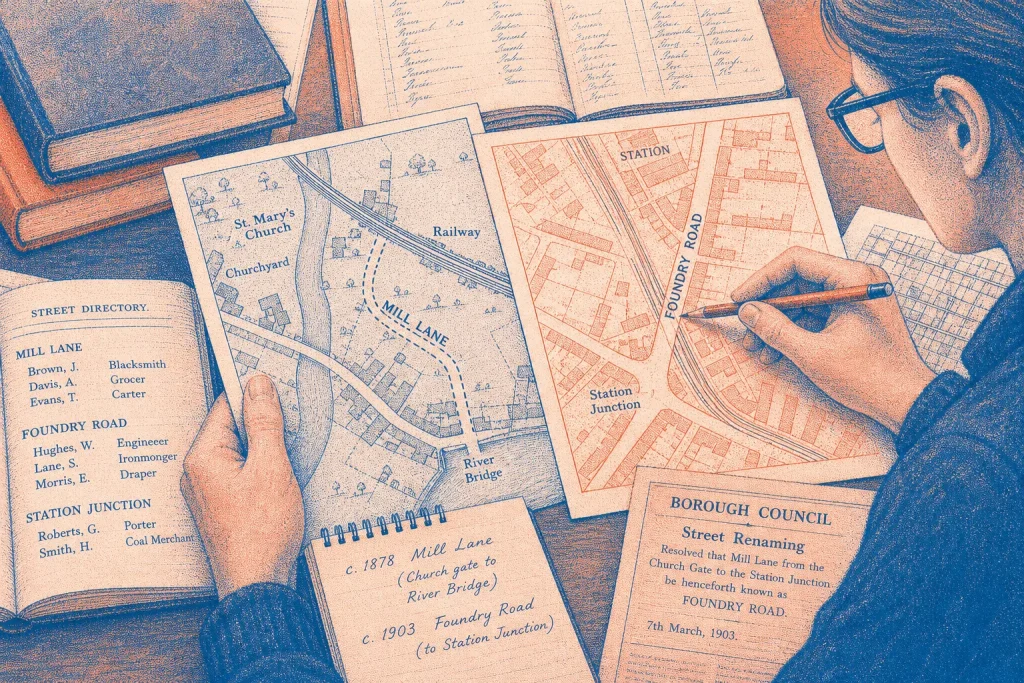
Which road did an old street name actually refer to? Begin with a fixed stretch between recognisable junctions, then compare how maps, directories and local records name it. The wording may change while the route stays put, or the road itself may shift beneath a familiar label. Keeping those questions separate makes the history easier to describe accurately.
Pin down the stretch
Choose a section that can be located on a present-day map. Note its current name, the junctions at either end and landmarks such as a bridge, church, station entrance or public building. If the road crosses several neighbourhoods, specify the part you mean.
This matters because a name can recur in different parts of a town, and a road can acquire a different name at a junction without a formal renaming. An old reference to “High Street” cannot identify a particular route by itself.
Save the current map or record its title and date. Use the junctions and landmarks as anchors when you move to older sources.
Follow the route
Compare dated town plans, Ordnance Survey maps, estate plans or fire-insurance maps held by a library, archive or mapping service. Check each map’s date, scale and purpose: a detailed property plan and a broad town map may label streets differently because they serve different needs.
Align the maps using physical features such as a river, railway, churchyard boundary, square or junction. Then trace the road’s course, rather than matching labels alone. A street may have been straightened, extended or cut by a railway; a new road may follow only part of an older lane.
Say you are comparing two invented maps of a lane beside a railway. The earlier plan shows it running from a churchyard gate to a river bridge; the later map shows a road with a new name from the gate to a station junction. First, match the gate and bridge or junction against the present map. Next, trace the line on each plan. If the station junction lies on the old lane’s course but the river end has disappeared, describe the surviving section as a possible continuation and leave the missing section unresolved.
A missing label is not proof that a road had no name. Record what the map displays, including gaps, without filling them by guesswork.
Read directories by edition
Street directories can connect names with addresses, residents and local services. Search editions close to the dates of the maps, and inspect nearby street entries as well as the index. A former name might appear as a cross-reference or as part of a neighbouring street’s listing.
Check how each directory is organised. Some group entries by street; others list residents or businesses and may cover only selected places. A directory heading can preserve an older form after a map adopts a new one, or use a shortened name without signalling an official change.
For every entry, record the edition date, name as printed and any nearby addresses or landmarks. If a directory says “Mill Lane” while a map from around the same period says “Foundry Road”, keep both forms attached to their sources. House numbers may help match the route, but numbering can change too.
Find the naming record
Maps establish that a name appeared by a particular date; they do not usually explain who adopted it or why. Look for council minutes, renaming notices, local newspaper reports, rate books or planning records. A local studies library, council archive or catalogue may hold relevant material.
Search for both names alongside terms such as “street renaming”, “road name” or “petition”, and include the local authority’s name. If a notice gives a reason, report it as the reason stated in that record. It does not establish that everyone used the new name immediately.
If the old name appears in one dated directory and the new name on a later map, but no decision record survives, describe the change as falling between those sources. Do not supply an exact date or motive that the evidence cannot support.
Track route and name
A renamed road may also have been widened, shortened, diverted or joined to another street. A route may stay largely in place while its name changes, or a single historic name may cover land now divided among several roads. Treat the name and the physical route as separate lines of enquiry.
At each map date, note the road’s junctions and its relation to boundaries such as a river, railway or property edge. If these anchors remain but the label changes, the name may have changed while the route persisted. If the anchors or road line shift, describe that alteration as well. Where a section cannot be matched securely, call it a possible continuation rather than a settled identification.
Make a source record
Use a compact record for each source. Include its title, edition or date, page or sheet, and archive or catalogue reference. For a digital item, save the catalogue reference and the date you viewed it, since online collections and links can change. Keep enough surrounding streets in any working crop to show how you located the road.
- Check the present map for the road’s current name and end junctions; if both are clear, use them to define the stretch, but if either is unclear, choose a better-located section or mark the boundary as uncertain.
- Check each historic map’s date, scale and purpose; if these details are available, record them before comparing labels, but if they are missing, treat the map as limited evidence and seek a dated catalogue description.
- Check whether junctions and landmarks align across maps; if they do, trace the route between them, but if they do not, record the mismatch and avoid claiming the roads are identical.
- Check directories for the street index, nearby entries and edition date; if a name appears with matching addresses or landmarks, record the connection, but if it appears only in a bare heading, keep the identification tentative.
- Check for a council notice, minute or newspaper report naming the change; if one records a decision, cite its date and wording, but if none is located, give only the interval between dated sources.
- Check whether the road line, boundaries or junctions changed as well as the label; if the route is stable, describe the name change separately, but if the route shifts, document both changes or leave the match unresolved.
- Check that every claim in your account points to a named source; if the source supports only a spelling or date, limit the claim to that evidence, but if it supports a route identification too, explain which landmarks make the link.
A clear entry might read: “Foundry Road, between Market Street and the canal; an earlier plan labels this stretch Mill Lane; a later map uses Foundry Road.” Add the source details and, if the precise transition is unknown, say so. List former names in chronological order only when dated sources support that sequence. Distinguish a formal change from a shortened or locally used form.
When writing for readers, give the current name first and place a former name in parentheses on first mention. For a discussion of a particular period, use the name found in that period’s source and make the date clear.
Keep uncertainty visible
Separate what a source says from what you infer. “The plan labels the road Mill Lane” reports an observation. “Mill Lane is the same route as Foundry Road” is an identification that needs support from junctions, boundaries or addresses.
If evidence conflicts, preserve the disagreement and name each source. A careful account can say that a directory uses one form while a map uses another, or that only part of the old route can be matched. That precision gives the next reader a useful place to continue.